
Supply chain is the hidden engine of business growth. Managing the supply chain means overseeing freight transportation, 3rd-party inventory management, warehouse management, delivery management, and running the software for these end-to-end operations.
Amazon recently opened up their World class logistic infrastructure that can take care of moving your goods from your source until the customers home even if you are not selling the product via amazon.com. This is a huge milestone for any seller and they need not just rely on Amazon or Walmart or any other retail online stores to sell their products. For example, an influencer on Instagram or YouTube can sell their products on their own D2C website but still use Amazon’s logistics solution without having to list the products on Amazon.com.
Typically, this announcement on ASCS made me think to ask two different questions.
Question 1: What benefit does the seller get by using Amazon logistics rather than listing the product directly on Amazon.com?
1. When we sell our product on Amazon, depending upon the type of fulfillment we choose, there are five basic costs that we incur by selling it via Amazon. Some of the costs below can be completely eliminated.
A. Referral fee – This is typically anywhere around 15% that Amazon charges for bringing in the customers for the product.
B. If we choose FBM (Fulfilled by Amazon), then there is another $3 to $6 fee, depending upon the size and weight of the product,
C. Since Amazon is being used for fulfillment, it comes to inventory storage fees, and that typically costs between $.75 and $2.40 per cubic foot,
D. There is a return administration fee, and in this case, Amazon may retain up to 20% of the referral fee, even if the sale was returned,
E. Optionally, there is an advertising fee to promote your products.
2. When we sell our products using multiple partners, not only using our own DTC website, but also using Shopify, eBay, or any other social media, ASCS helps to manage a single pool of inventory.
3. As the consumer base grows for the product within the Amazon store, Amazon doesn’t provide the customer’s details directly to the store for any indirect campaign. The store with an Amazon.com has utilize their ad campaigns to promote its products.
4. If you are already an influencer over other platforms, then that can be directly utilized to market the product and can redirect the customer to the DTC website to perform the sale right at the DTC website itself.
5. To enforce our branding, we can let Amazon deliver the product in packaging that we use or we can request Amazon to go with unbranded blank box packaging that doesn’t have anything related to Amazon’s branding
Question 2: Why would Amazon open its logistics now?
ASCS itself existed as a separate freight, fulfillment, and parcel delivery arm. However, Amazon bundled these standalone entities into an enterprise utility that any business can use regardless of whether they sell on Amazon.com or not.
1. Few decades ago, Amazon built highly reliable, massively scalable, distributed, and structurally complex data centers to manage its retail online business. They later extended this infrastructure as a white-glove and white-labeled virtual data center for other Enterprises. They called this AWS. In my view, they utilized the same strategy, principles, and philosophy for their highly sophisticated, modern, and scalable supply chain network to launch ASCS.
2. Opportunity to grab a slice of the $1 trillion economy that the third-party logistics providers hold.
3. Opportunity to maximize the asset utilization that is unused internally.
Let’s do some simple math to understand if using ASCS is really beneficial to the seller or not.
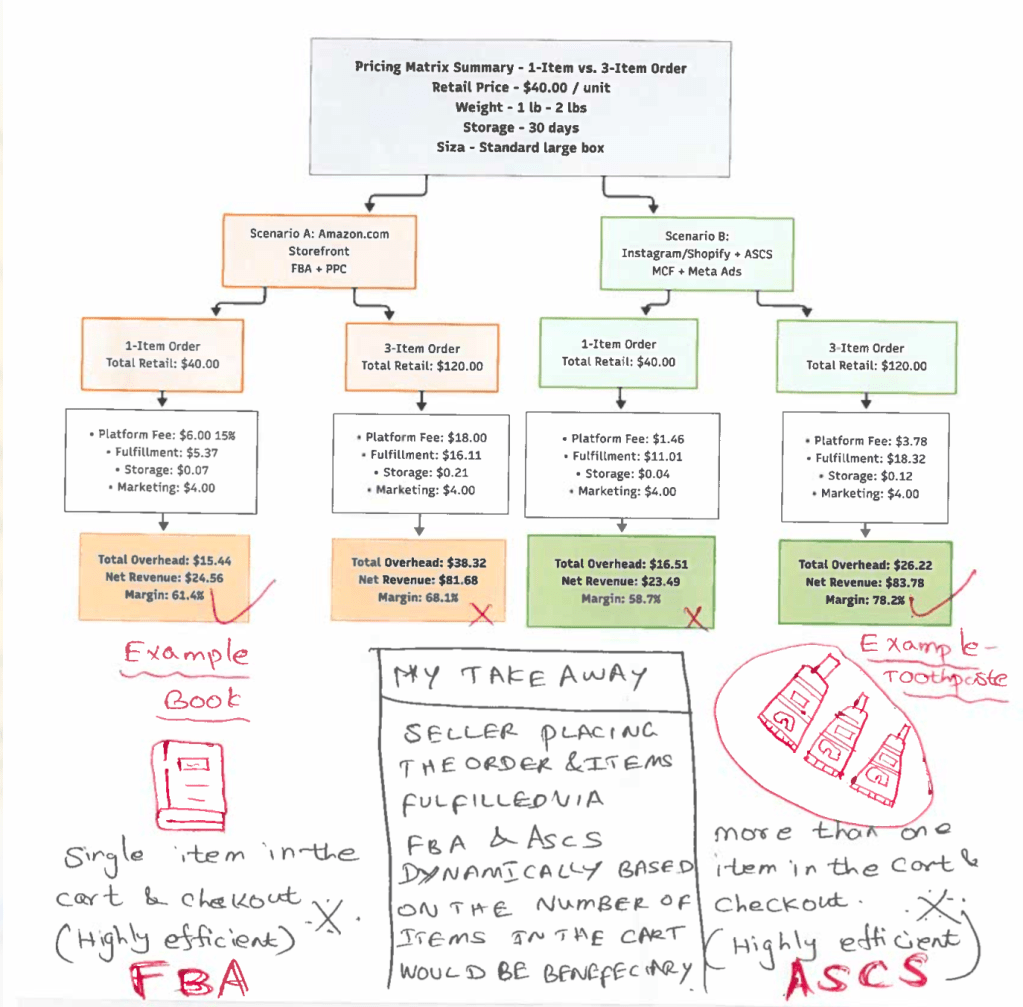
Based on my understanding, profit margins increase significantly depending on the number of items sold in a single cart. The data clearly shows that while the standard FBA structure is highly efficient for a single-item cart, the ASCS (Shopify/MCF) model becomes far more profitable when multiple items are bundled together in a single order.
Now, let’s see in detail the three high-level entities that constitute ASCS.
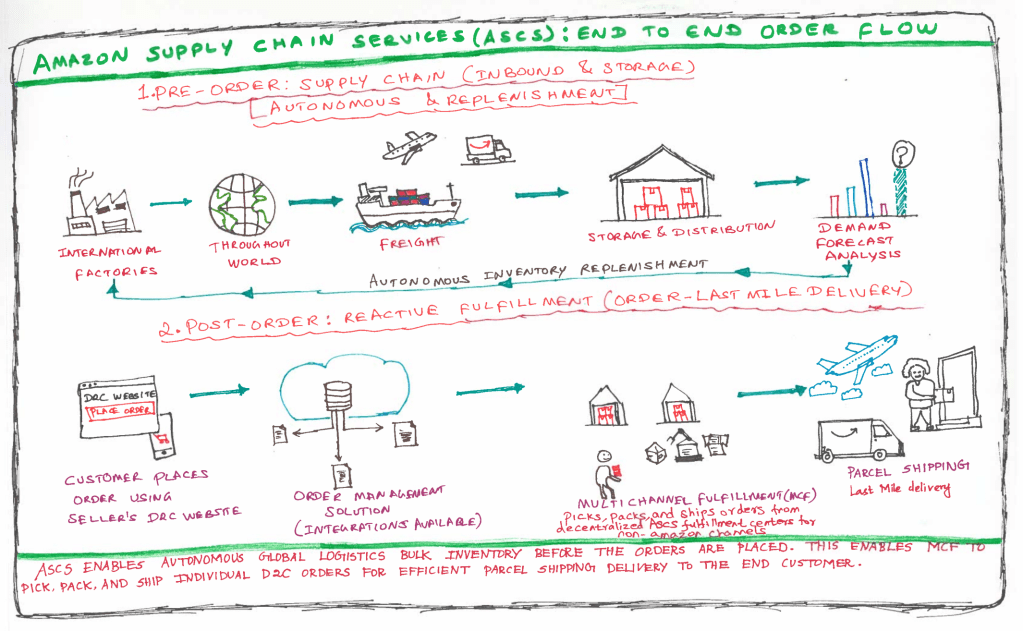
1. Freight – Everything starts from here. This is the inbound transportation phase, which handles moving the bulk of the inventory from manufacturing facilities or ports into the fulfillment network. This component also takes care of custom clearance. This provides flexibility in the load that we ship by including an option called less-than-truckload (LTL) shipping.
2. Distribution and fulfillment – Once the inventory arrives, this component manages how the stock is split, housed, and again picked for the final leg of delivery. This itself is broken into two distinct sub-services.
a. Storage and distribution – This focuses on low-cost bulk storage. It acts as a safety stock layer, keeping the bulk inventory ready for the most part to be systematically distributed into the active Amazon network or to the third-party destinations as demand fluctuates. Amazon takes care of replenishing the stock based on the minimum inventory set, and it helps to set the right inventory across different warehouses based on the demand forecast in the particular region.
b. Multi-channel fulfillment (MCF) – This is the core order execution engine for the non-Amazon sales channel, such as independent websites, Shopify, or any other social media platform. MCF handles the physical picking, packing, and shipping of individual orders using Amazon’s existing logistics footprint. This uses the same Amazon network that will be used by Amazon itself to deliver when the customer orders from amazon.com, but except that this will be a white-label delivery.
3. Parcel shipping – This is the final piece of the chain, and it focuses on individual package delivery. This ensures that outbound orders are successfully routed through the localized parcel networks and delivered directly to the customer efficiently. There are standard and expedited delivery options. One thing that I noticed, ASCS does not let the customer choose a gift wrap like they generally do it in amazon.com. That is currently not supported via ASCS for MCF customers.
How can we programmatically integrate ASCS with our needs and applications?
To implement the end-to-end process, we will need to interact with ASCS developer ecosystem. ASCS bridges both selling on Amazon and off Amazon channels. The API for both are hosted across the Selling Partner API (SP-API).
I was trying to understand the API that would utilize MCF.
A. Supply chain / Fulfillment inbound API (Pre-Order / Autonomous) – This API handles the freight and bulk storage & distribution portion of our diagram.
What does it do? It allows us to programmatically create inbound shipments, generate box labels, track ocean or truck freight, and monitor bulk safety stock levels before items reach an active fulfillment center.
Key operations – createInboundPlan, getShipments, getTransportDetails.
B. Fulfillment outbound API (Post order/ Reactive) – This is the engine for Multichannel Fulfillment (MCF). It kicks off reactively the moment a customer places an order on your D2C website.
What does it do? It submits the D2C customer’s shipping address and item details to Amazon to trigger physical picking and packing. It also allows you to check real-time stock availability in local fulfillment centers before showing a ‘Place Order’ button to the user.
Key operations – createFulfillmentOrder, getFulfillmentPreview (used for calculating dynamic shipping fees and delivery dates), getFulfillmentOrder.
C. Shipping API v2 (Parcel shipping) – This handles the last-mile parcel shipping logistics.
What does it do? If you use Amazon Shipping to deliver packages directly from your own warehouse or want advanced programmatic tracking/label generation for outbound regional parcel networks, this API provides access to ground/air rates and real-time package tracking.
Key operations – purchaseShipment, getRates, getTracking.
Share your experience on implementing 3PL using Amazon’s automated grid.If you are looking to integrate ASCS into your architecture, you can explore the developer workflows and individual endpoint specifications directly in the official Amazon Shipping API v2 Reference.
Happy learning!

