
I had the opportunity to use three popular application development tools: Cursor, Lovable, and Replit. These tools heavily use AI. I used them for my personal projects. I have documented my observations based on my usage of the tools for various projects.
At a high level, these tools are good for taking the application from design to production for a limited number of user groups. It is also a quick prototyping tool that helps evaluate ideas efficiently.
How is AI reshaping the developer’s world?
The shift from traditional decade long IDEs to AI-native environments represents a new way of Scope Driven Development using vibe coding techniques. In these tools, you act not only as a developer but you are a product manager, quality reviewer, infra manager, and go-to market specialist. It is achieved by using specialized agents that help you through the entire software development lifecycle (SDLC).
Below are some of the key areas that we have to learn as developers going forward –
1) FinOps – In traditional development, FinOps focuses on the server costs. In AI-native IDEs, it introduces 2 major areas of cost management –
a) Cost to build – This is related to the inference cost management to build the application using the prompts. Developers have to ensure prompt efficiency. The ‘cost per line of code’ is now tied to token consumption. Efficient, context-rich prompts directly reduce your monthly ‘burn rate’ of AI credits. In the future, the efficient developers are the ones who could effectively manage the tokens and build high quality applications. Also, high end tools allow you to switch models based on task complexity – using cheaper models (like Gemini Flash) for simple refactors and premium models (like Claude 3.5 or GPT-5) for complex architecture.
b) Cost to run – This is also baked within the AI dev product. Tools like Replit and Lovable bundle hosting and compute directly into their core plans, often starting at around $20–$25/month. They provide seamless integration to backend features like authentication, storage, database, secrets management, LLM integration, security scans to flag exposed secrets, XSS risks, and database vulnerabilities that the AI may have introduced.
2) Cloud Integration –
While traditional IDEs require manual cloud configuration, AI IDEs vary in their approach:
a) Cursor (Local & Cloud-Native): As an AI-first local IDE, Cursor sits closer to the machine. It doesn’t hide the cloud but helps you write the necessary scripts (Terraform, CDK) to wire your own stack (e.g., Supabase or Vercel) manually.
b) Replit, and Lovable(Abstracted Cloud): Replit/Lovable offers an all-in-one cloud development experience that runs entirely in the browser. It abstracts the infrastructure, providing built-in databases, hosting, and one-click deployment natively.
3) Visual Edits – The boundary between design tools like Figma and the IDE is blurring. Lovable/Replit features a specialized ‘Visual Edit’ mode where you can modify elements directly on the screen without typing code. You can change sizes, colors, and layouts visually, and the AI translates these “Figma-like” interactions into code. These tools understand the utility of individual components within your design system, allowing for granular AI support for every element.
4) Specialized Agents – The monolithic IDE is evolving into an orchestrator of specialized AI agents. Each agent focuses on a specific aspect of the SDLC, working collaboratively to achieve your goals –
a) Publishing agent handles the entire CI/CD pipeline, checking for deployment blockers, automating releases, and ensuring a smooth path to production.
b) Before you write a single line, an architecture agent might plan your database schema, suggest optimal folder structures, and even diagram your system’s components.
c) Coding agent generates the actual implementation based on your requirements.
d) Rather than writing tests manually, a testing agent can observe the code being written and automatically generate comprehensive unit and integration tests.
5) Separation of Concerns (SoC) – In AI-native development, Separation of Concerns moves from a manual coding discipline to an automated architectural standard.
a) Developers can prompt the AI to define the interface or contract between different parts of the app first. This allows the Frontend Agent and Backend Agent to work in parallel without stepping on each other’s toes, maintaining a strict separation between different functional concerns.
b) AI tools help maintain a clean boundary between the UI, business logic, and database layers. For instance, Lovable automatically separates the frontend (React) from the backend (Supabase), ensuring that a change in the design doesn’t accidentally break the data layer.
c) Instead of creating a ‘giant’ file, AI agents suggest breaking code into modular, reusable components. They can identify when code is becoming too tightly coupled and suggest a refactor to maintain the single responsibility principle.
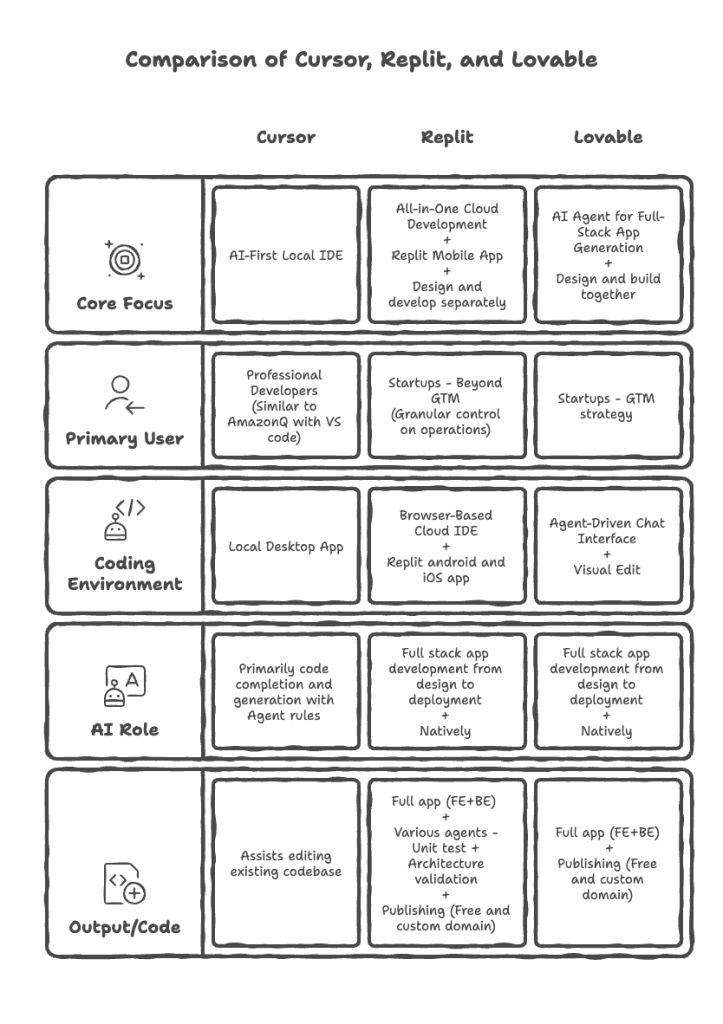
Also, summarized the high-level features of the respective platform in the diagram below –
What has your experience been with the future of AI-based development?
Share your thoughts!
 Shankar's Blog